Thursday, 23 July 2015

The Herb Garden

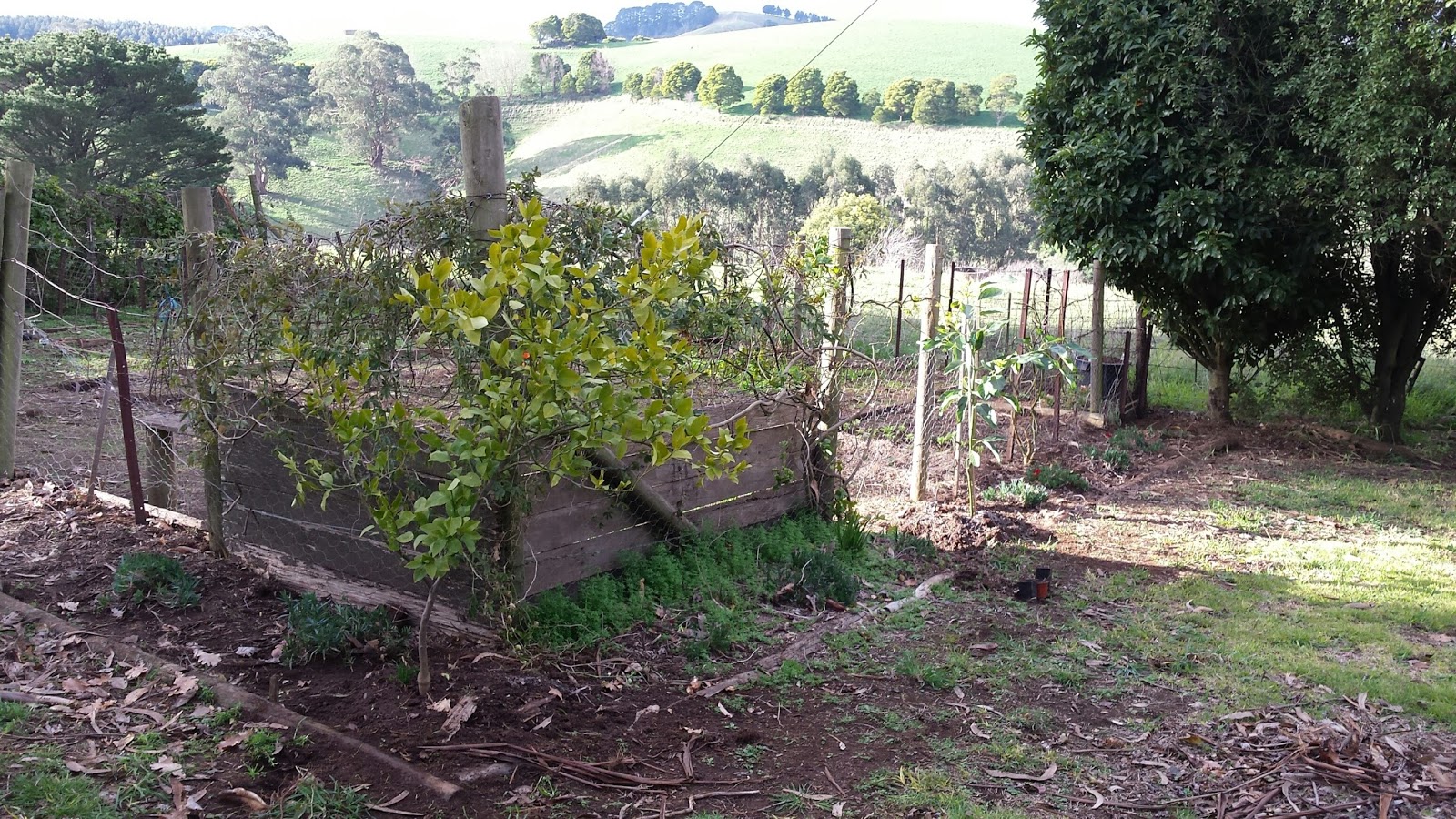
The healthy looking avocado tree.
The planting along one side, herb garden, chives, lettuce, strawberries,
dwarf rhubarb, garlic and the kaffir lime.
It seems as though establishing the herb garden and the decorative floral border around the Kitchen Garden has been my way of procrastinating over how to actually start the kitchen garden. I'm not sure why I feel ill-equipped to set this up, but I need to hit the gardening books and sort out a design pronto because after clearing the it out completely, all I have managed to do is plant down one side and if I don't get to putting in some actual garden beds soon the weeds will devour the cleared ground all over again!

Still, I now have the beginnings of a lovely Herb Garden.

After another visit to the Diggers Club shop at Heronswood I came away with:

- Rosemary (plant)
- Thyme (plant)
- Lavender (plant)
- Moroccan Mint (plant)
- Spearmint (plant)
- Stevia (plant)
- Wildflowers for Bees (seeds)

I also had a sad looking basil plant from the supermarket to put in the ground (not sure if that will live) and 8 cuttings from blackcurrant and redcurrant bushes kindly given by a friend. What these even look like as plants is beyond my knowledge at this point as right now they just look like sticks, but I looked online to find out how to plant them and now they are in the ground along the same fence as the blueberries and raspberries.

The modest beginnings of a herb garden, hopefully it will fill out a bit in spring.
The herbs are all planted in a sunny corner of the kitchen garden. The mint plants I put in a pot on the advice of my lovely mother in law, as they will apparently run riot and take over the garden if you don't keep them contained. The rosemary, thyme, stevia and basil went in with the continental parsley, coriander and oregano that I had already planted.

The decorative border, before...
...and after! With the succulents and flower seeds all tucked in.
The decorative border outside of the garden, which already had some flowers planted, was overgrown with weeds too. So we cleared that out and put in more plants and flower seeds to attract bees and encourage 'helpful' bugs. I planted the Diggers' wildflowers for bees mix (conflowers, dill, poppies, flax, salvia, pincushion and coriander), Flanders Poppy, Aquilegia (which I know nothing about, but my Aunt gave me seeds saved from her old farm), Nasturtium Ladybird (which you can eat in salads), and lavender.

I also managed to get the lemon tree and all of the succulents saved from our last house into the ground, then added to the main garden the kaffir lime and a dwarf rhubarb. Closer to the house I added a small persian rose bush called 'for your eyes only' to the garden and I planted the coffee bush, which wasn't looking particularly healthy (though that could just be the cold), near one of our water tanks which is prone to overflowing. Apparently coffee plants like plenty of water.


Friday, 3 July 2015

New plants :)

The fruit selling is going well, not yielding hundreds of dollars yet, but giving me enough to purchase some starter plants. After saving all profits for a few weeks I went and splurged at the local nursery and bought:

- 1 Avocado tree (Hass) which is about 5 foot tall and should be productive within 2 years
- 2 Blueberry bushes (Northland and Denise)
- 7 Raspberry canes (Nootka, Autumn Heritage, Chilliwack)
- 11 Strawberry plants
- Peat bricks (for planting the avocado tree)

The Strawberries like to be planted on top of a mound and then mulched with straw, or in my case, sugarcane mulch generously left by the farm's former owners.

Strawberry mounds, mulched well with Sugarcane mulch

Northland Blueberry


It might sound incredibly ignorant, but I didn't even know that different varieties of the same type of plant fruit at different times of the year! So the idea of buying several varieties of berries is that they fruit at different times of the year and you get fresh fruit for longer periods.

Denise blueberries will fruit early October to January and Northland will fruit for a different and longer period, December to March. With a bit of luck we'll have blueberries for 6 months of the year!

The same applies to the Raspberries. These I had to plant in a particular way, along a supporting fence oriented North-South for even sunlight. I needed to dig a trench along the bottom of the fence and add manure and peat to the soil before planting. The peat I bought at the nursery and the manure I was lucky enough to get for free from a neighbour with horses :)

Blueberry bushes and Raspberry canes planted and ready to go!
Woohoo! Free horse poo!


The Avocado tree needed special attention, apparently my usual method of planting trees (just sticking them in the ground) wasn't going to cut it.

So I chose a nice, sheltered spot with at least 4 hours of sunlight per day. There is a slope to the site to aid drainage as Avocados need well drained soil. I dug the hole and added peat to the bottom as per the advice of the lovely lady at Town Centre Nursery in Mirboo North then popped in my new tree, built a mound around the base, dug a channel on each side to hold excess water and hoped for the best!


Tuesday, 30 June 2015

Progress in the Kitchen Garden!


Well, it seemed to take forever but the kitchen garden is now finally weed free!


The garlic I planted in the north-east corner has sprouted and even though I want to reconfigure the garden beds, I needed to get a few things in the ground so I have planted them against the southern border.


We now have planted in this garden:

- Garlic
- Strawberries
- Heritage Lettuce
- Chives
- Coriander
- Parsley
- Oregano

And the passionfruit vines are doing nicely along the fences.

Making Kombucha

In the last 6 months or so my husband and I have become aware of Kombucha and started to consume it on a daily basis.

It is a fermented drink made from tea and sugar which carbonates naturally, so it is a fizzy and refreshing alternative to soft drink AND it's good for you!

Kombucha is a probiotic and many people believe that it has a range of health benefits, from reducing the grey in your hair to boosting your immune system and aiding liver function.

It is about $8-10 for a 700ml bottle at health food shops, so I decided to try making it myself.

I mentioned this to the lovely people at Peninsula Fresh Organics and they happily gave me tiny SCOBY from their brew to grow, though you can leave a bit of kombucha in the bottom of a bottle and it will start to form solid parts, these are tiny new scobys forming.

What is a SCOBY? It is an acronym- Symbiotic Culture of Bacteria and Yeast- anyone who has worked in a bar will have seen (and smelled) the beer yeast forming into a scoby, but this SCOBY is formed using tea and sugar which is then allowed to ferment.

I kept my tiny SCOBY in a container with about a cup of kombucha, in a warm, dark place for about two months and after that time something that looked a bit like a jellyfish began to form.

I then looked up recipes for Kombucha on the internet- this is an amalgamation of the info I found:

 You need:
- 1 SCOBY
- 1 cup of kombucha
- 2 large (2litre or more) glass jars- cleaned and sterilized
- 5-6 organic teabags (green or black)
- 1 cup of organic sugar (I used Panela, so my kombucha turned brown)
- 5 cups of water
- a piece of cloth to cover the jar and string or a rubber band to secure the cloth

Instructions:
- Boil 4 cups of water
- Add the teabags and let them steep for 15 minutes
- Add the sugar and stir until dissolved
- Add another cup of water
- Leave mixture for about an hour or until completely cooled
- Place the SCOBY and the ready-made cup of kombucha in a glass jar
- When the tea and sugar mixture is cool, pour it into the jar as well
- Place the cloth cover over the top of the jar and secure
- Leave undisturbed in a warm, dark place (like a cupboard near the stove) for 7 days- must be kept out of sunlight.
- Test your Kombucha after 7 days by dipping in a straw, holding your finger over the end, and drawing out some of the liquid.
- If it is too sweet, leave it for another day or two.
- Don't leave it too long or it will turn bitter.
- Pour into a bottle, leaving the scoby and a cup of kombucha in the jar for the next batch, and store in the fridge.
- Consume about 200ml per day
- Kombucha is naturally fermented product that will become alcoholic if you leave it for too long...


Thursday, 18 June 2015

The things you take for granted living in the suburbs...

So I was talking to a friend the other day, she was wondering how well we are settling in to our new home. I didn't immediately gush about the wonders of country life and just said honestly that, even though this is amazing, it has been an adjustment.

It isn't just a new house, it is a completely new way of living.

A lot of the things I took for granted living in the city and the suburbs just don't happen here, or you have to work harder for them.

Take rubbish collection for example. We used to sort rubbish from recycling and green waste, put the bins out every week and have it all magically taken away.

We don't have any rubbish collection here, so we have to sort into 5 bins:

- Compost (and we have 2 compost bins outside but I think I've been putting things in there that you're not supposed to like citrus and bread)
- Paper and cardboard- this goes into the wood fire
- Green waste- which is either composted or burnt off
- Recycling- bottles and plastic containers that I cannot re-use
- Rubbish- mainly plastic packaging

Interestingly, we now seem to only accumulate about one small shopping bag full of actual rubbish (sometimes not even that) per week and about the same of recycling. We take this with us when we visit someone with rubbish collection and put it in their bin usually, otherwise it would have to collect until we had enough to take to a tip somewhere.

Then there is the water. We are on tank water, this means using water more carefully (not taking excessively long showers), and filtering all drinking and cooking water through a Brita Jug, even to brush your teeth. We have an electric pump to push the water through the pipes and we can turn it off at night or when we go away to save power.

The mail delivery is different here, twice a week the postie does the rounds of the letterboxes on the main road (which is a dirt road too narrow for cars to pass in some areas). We had a charming little dilapidated letterbox until last week when someone took a corner too fast in their car and took out our letterbox in the process (our neighbour believes this was not accidental and was rather annoyed). So we collect our mail once a week at the local post office in Mirboo North, which is a 15 minute drive from here.

The last really obvious difference, particularly now in the middle of winter, is our heating. Our entire house is heated by a slow combustion wood heater. This works quite well and gets the house surprisingly toasty for its size but of course, we need to supply the wood for it.

Our nearest neighbour dropped over a few barrow loads full of hardwood and kindling when we first got here, which was a really nice thing to do, but that lasted about 2 weeks and the small supply of wood left by the previous owners was dwindling fast. We could buy it, which is an expensive exercise at $180+ per cubic metre, (about enough for 3-4 weeks) and that's when you go and get it in your own trailer. Or you can cut it up yourself, from wood available on your property.


On our small farm of 11.5 acres, we had 2 dead trees that needed chopping down and could be used for firewood, so we bought a chainsaw and after a few u-tube lessons, my husband got to work chopping one down. It all went really well and fell where it was supposed to, not damaging anything else in the process. He cut it up and we all took it in wheelbarrow loads back to the hayshed to stack up ready for use, which really boosted our depleted stores.


Some of it was huge and wouldn't fit in the heater, so we had to buy a splitter (an axe with a different shaped head) to chop it apart. I had a go at this and it is hard work. The cyprus falls apart fairly easily but you can hack away at the gum for ages before it breaks.

So the first thing I do every morning at the moment is to empty the ash pan outside, grab some kindling and larger pieces from the wheelbarrows full of different sized wood parked on the veranda, bring it inside, scrunch up newspaper and start the fire.

I'm not yet longing for the simplicity of turning on a switch and having instant heat, but all of this gives you a greater appreciation of how easy it has been to enjoy modern home comforts available in the suburbs.


Sunday, 7 June 2015

Progress on the Kitchen Garden...


A couple more afternoons digging up weeds and I almost have a clear kitchen garden!


This revealed more garden beds and the remnants of an irrigation system:


With the end of the weeds in sight, I now have to decide how to arrange the new garden beds. The ones that are already in place don't seem to make a lot of sense to me, though I admit that being new to all this, there may be very good reason for them to be configured the way they are.

I think that it might be easiest to start with 8 rectangular beds, raised about 20cm. This is not only the easiest to build but the easiest to work with to start.

Then I need to find some soil to fill them with, preferably from somewhere I was going to excavate anyway, add compost, manure, MycoGold and rockdust.

Then it might be time to plant something...

Wednesday, 27 May 2015

The Kitchen Garden...

There is an existing fenced vegetable patch not far from the house, about 8x12 metres, completely overgrown with weeds.

The first gardening task is to get it up and running as a kitchen garden with herbs and whatever vegetables I can plant in winter.

I have spent a few hours over a couple of days digging out the weeds with a mattock. It's pretty hard going for someone whose body has not been conditioned to heavy manual labour, but we're getting there....

A bit of a mess to begin with, that's the passionfruit vine along the north fence.


 The first few hours clearing uncovered trellises, a couple of drums for water and garden bed outlines...

The next lot of clearing, it's starting to look like something you might recognise as a garden bed. We planted 5 small rows of garlic in the northeast corner, we'll see how it goes, they might have been put in a bit late.

Even after all this, it might be a bit too shaded to grow vegetables, there are a some large gum trees which block the sun in the afternoon.

Like everything else here it will be a bit of an experiment at first!